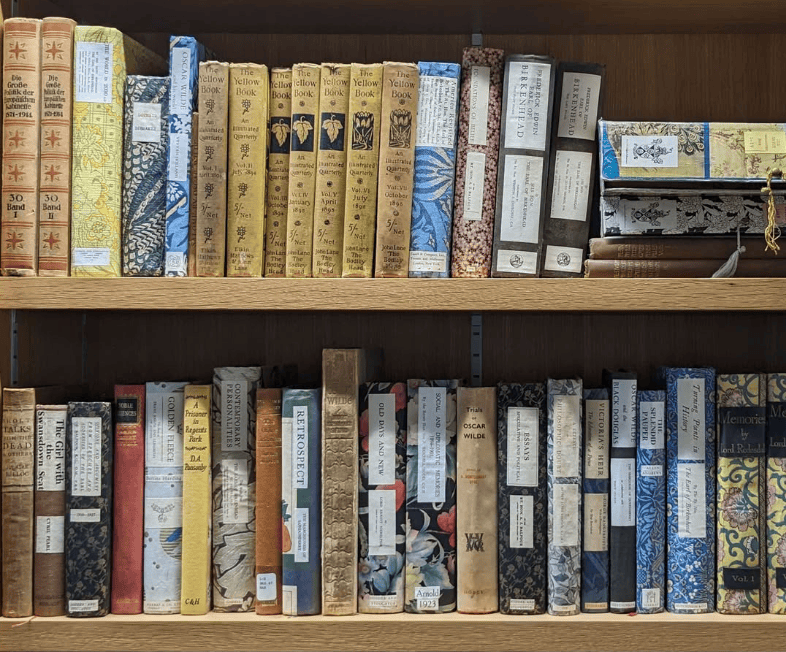
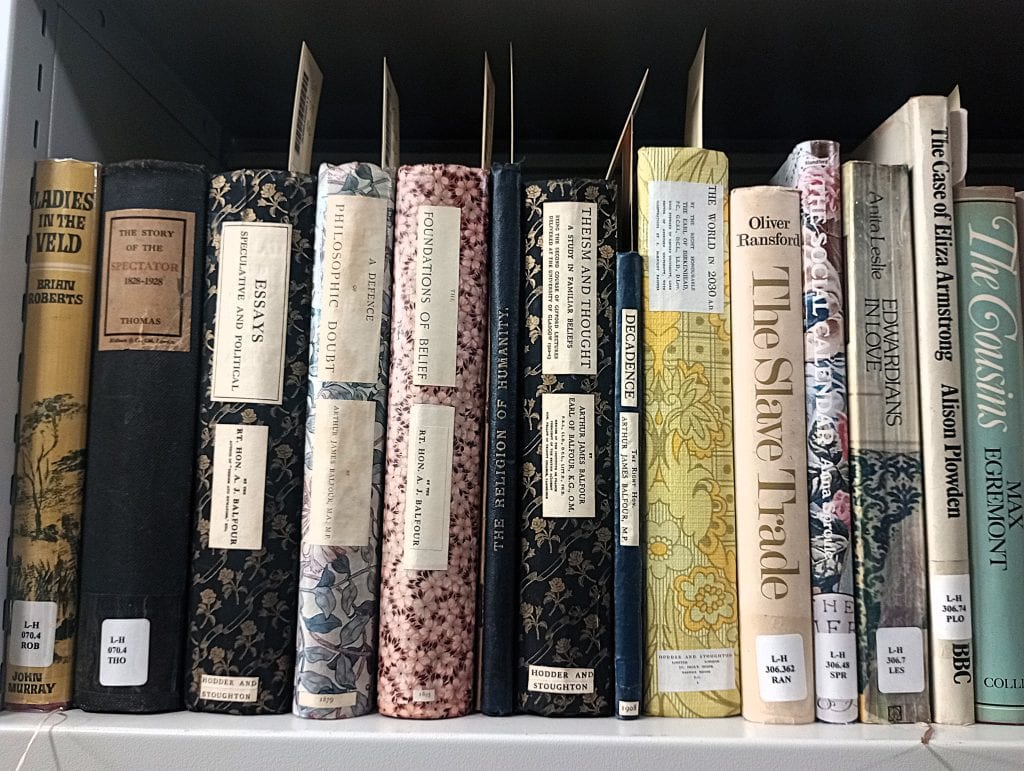
The Lascelles-Hadwen Collection may be one of the lesser-known special collections at Magdalen, but it offers much for researchers to enjoy. Not only is it our most colourful collection – at least 50 of the books have been rebound by the donor in beautiful patterned papers, and/or “grangerized” (embellished with cutouts from other works) – it is a rich source of information on late 19th and early 20th century Britain, bringing together books that cannot be found in one place anywhere else in Oxford.
Alongside the lives and works of icons such as Aubrey Beardsley, Aldous Huxley and Osbert Sitwell, sit biographies of at least 30 of their friends and contemporaries, plus collective studies of the theatres, gentleman’s clubs, stately homes and fashion trends that influenced the spirit of their times. There are also plenty of contemporaneous novels, essays, and philosophical works, along with a selection of world history, putting the glamour of London’s literary and artistic circles into wider context.
The collection’s route from its donor’s home to Magdalen was not without obstacles, as this blog post will discuss, but is has now been safely housed with us for over 30 years, making the time ripe for a deeper look at what it can offer. Recent work on the collection has resulted in all the books being fully catalogued on SOLO. The main part of the collection has also just been moved to a new location within college, where better environmental conditions will help preserve it for the future.
Who was Francis Edward Lascelles-Hadwen?
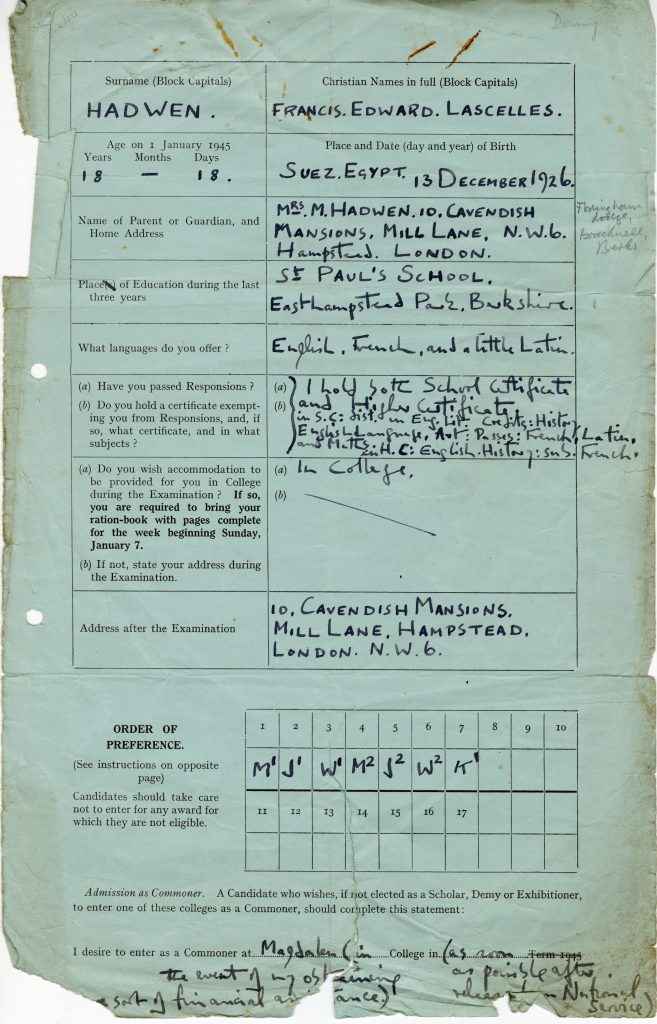
The donor of the Lascelles-Hadwen Collection was a Magdalen alumnus, whose time studying Modern History at Magdalen was a great personal highlight. In correspondence from the mid-late 1980s with College Presidents Keith Griffin and Anthony Smith, Francis Edward Lascelles-Hadwen repeatedly refers to the College as ‘marvellous, magical Magdalen’.
Lascelles-Hadwen was born in Suez, Egypt, in 1926, and brought up in Hampstead, London. His father was Edward Hubert Lascelles-Hadwen, an RAF pilot who had served in the First World War. Sadly, his mother’s name is not known to us, but records suggest he had one brother. After being educated at St Paul’s School and at Magdalen, Francis Edward embarked on a prestigious and diverse career, starting out as an Honorary Secretary to Sir Winston Churchill and then taking up increasingly senior leadership positions in local politics, school governance, the Army, and the Conservative Party. By the time he began looking for a new home for his book collection, he was a high-ranking member of the Civil Service, working as Chairman of the Birmingham City Centre Crime Prevention Panel.
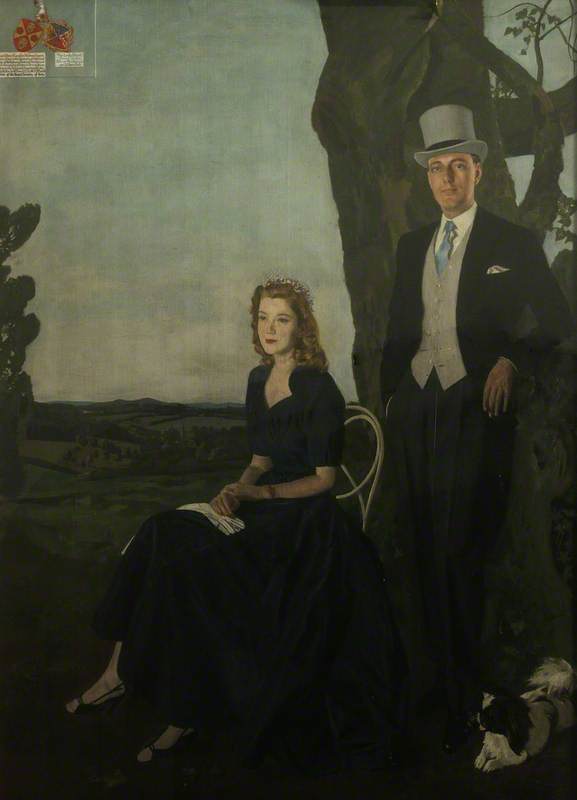
Lascelles-Hadwen was married twice: first to Lady Sibell Agnes Julia Blunt-Mackenzie, with whom he had a son and a daughter, and secondly to Clare Liversidge, with whom he had a son. There is a delightful portrait of Lascelles-Hadwen and Lady Julia (as his first wife was known) in the President’s Lodgings at Magdalen, donated at around the same time as the book collection.
Lascelles-Hadwen lived a long life, dying in 2014 at the age of 88.
The Story of the Donation
In his fifties, Lascelles-Hadwen decided that the extensive book collection he had built, bound and customised would be better placed in a library. Given his fondness for Magdalen, the College Library perhaps seemed an obvious choice. He approached the President and Librarian with the suggestion that a section of the Old Library be set aside for around 225 books ‘relating to Dandyism and the Fin de Siècle Decline of Empire.’
Though the College was pleased to receive such an offer, the idea of reserving space in the already almost-full Old Library was unfortunately not considered feasible. Nor were Lascelles-Hadwen’s rather flamboyant ideas about how the collection should be housed and advertised. Lascelles-Hadwen asked that his coat of arms be carved into the bookcase, and that this be accompanied by an unusually large plaque engraved with details of his time at Magdalen, including the location of his student room, a list of his tutors, and the name of his tutorial partner. He also wanted the collection to be opened with an opulent Wildean party, involving absinthe, green carnations, lobsters on leads, and an appearance from the Prince of Wales.
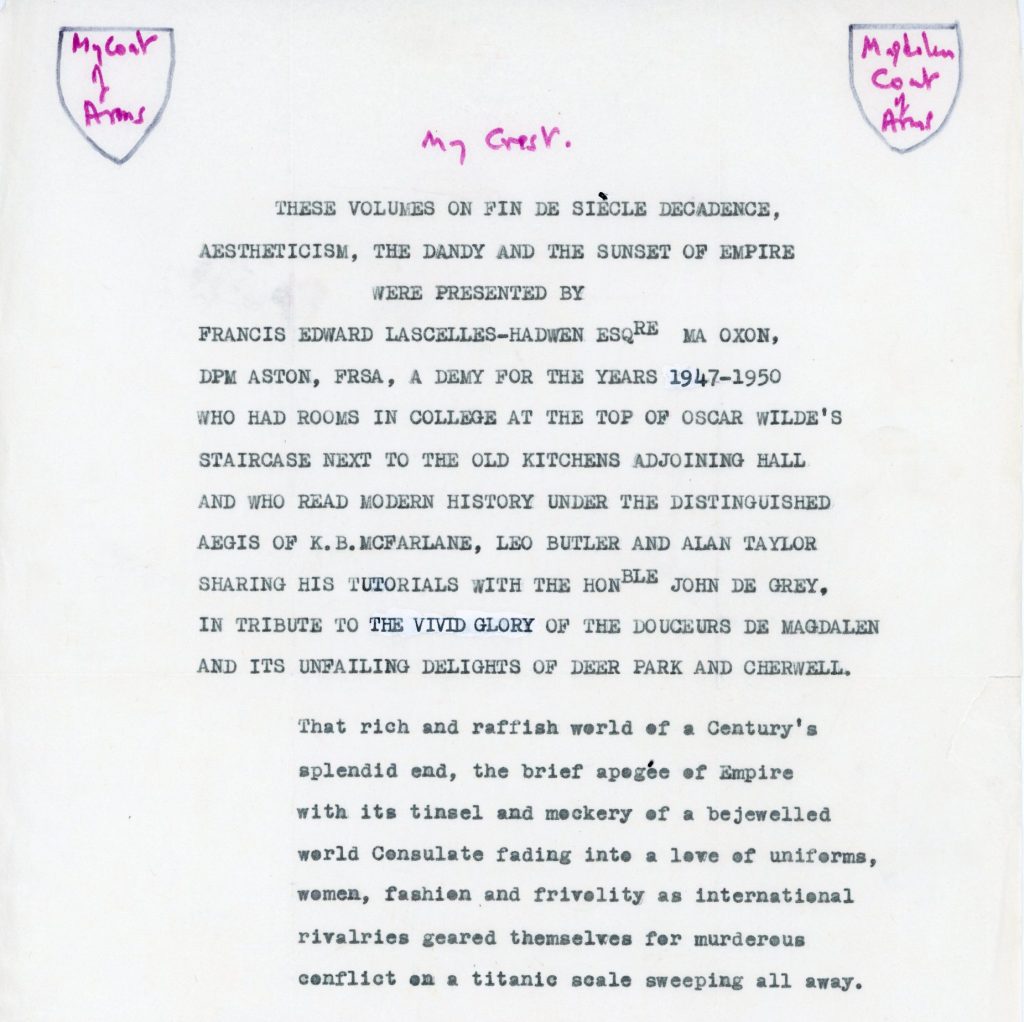
An uncomfortable correspondence ensued, in which the President, Librarian and Bursar tried to talk Lascelles-Hadwen round to their more conventional and admittedly less exciting protocols. Eventually, the College won out. Most of the books were housed in available Longwall Library storage or on a stairway in the President’s Lodgings, with just a few especially valuable items finding their way into the Old Library collection. These were intermingled with the existing shelving scheme.
A modest tea party and dinner were held on 24th November 1989 to celebrate the collection’s arrival. Lascelles-Hadwen volunteered a passionate opening speech. Unfortunately, his references to Wilde’s sexuality shocked several College officials, in an era when such topics were often still considered taboo.
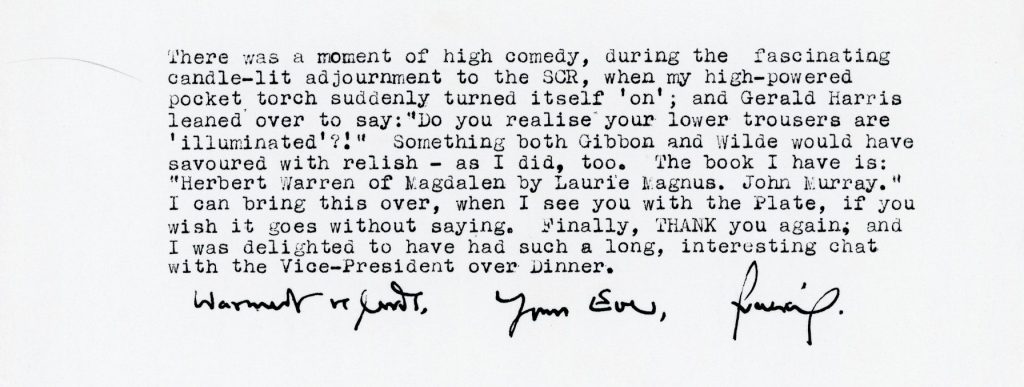
Amidst all of this controversy, what was perhaps overlooked by some was Lascelles-Hadwen’s real goodwill towards the College, and his wonderful enthusiasm and self-deprecating sense of humour. The letter below illustrates how much fun he must have been to have as a guest and friend.
The Collection Today
Recent concerns over the environmental conditions in the Lodgings stairway have provided a timely opportunity to reevaluate the collection. In late 2025, the decision was taken to move all the Lodgings books to the drier and more stable Longwall Library stacks, reuniting them with those already kept in the Longwall.
The move enabled the Special Collections Librarian to catalogue the books on SOLO, Oxford’s online catalogue, where they will be much easier for future readers to discover. Some very interesting items came back to light during the cataloguing process, including a set of first editions of the novels of Aldous Huxley, a full run of the scarce 1890s periodical The Yellow Book, and more than 20 books not held by any other Oxford library.
The move also offered a chance to look back over the College’s archive of correspondence with Lascelles-Hadwen, and to rethink how his ideas had been perceived. His vision for the collection might have been unusual, but his championing of flamboyance and dandyism would be much more warmly welcomed in today’s Oxford, as would his unbounded love for all things Magdalen. We hope that the new catalogue records, and this blog post, will help to revive interest in the tales of glamour and decadence that he collected so eagerly and bound so beautifully.
Written by Jessica Woodward, Special Collections Librarian.
Further Reading
A full list of the books in the Lascelles-Hadwen collection can be found here. To make an appointment to consult any of these books, please contact library.desk@magd.ox.ac.uk.
The College Archives hold a collection of papers relating to Lascelles-Hadwen’s donation. Enquiries are welcome at archives@magd.ox.ac.uk, but please note that under UK data protection legislation, the documents are not yet available for researchers to view.