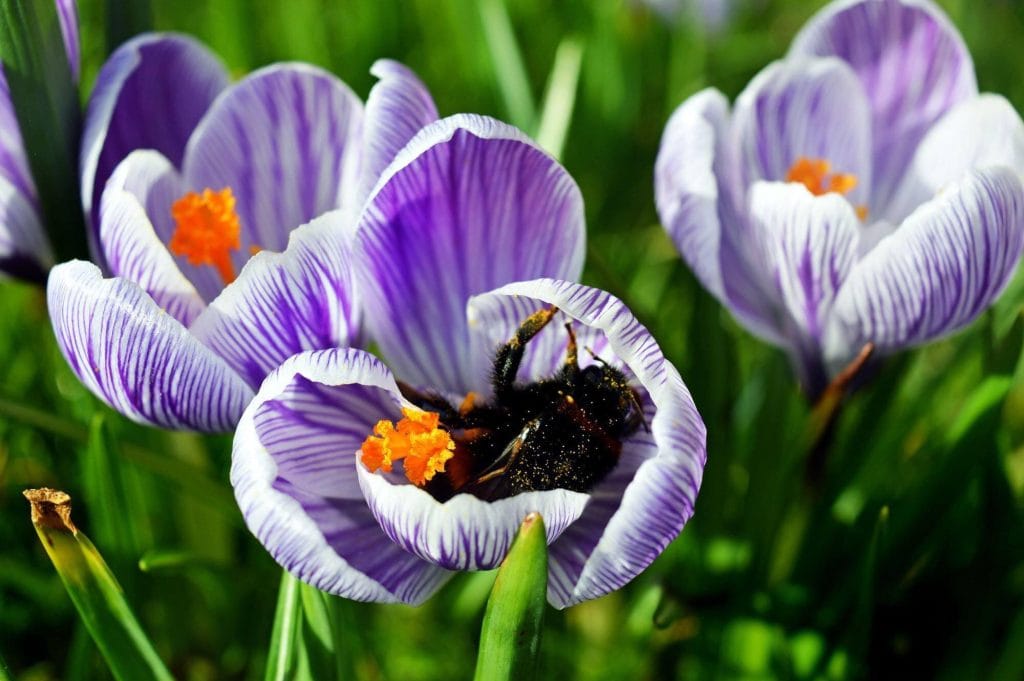
If you ask someone about the wildlife at Magdalen, most people will mention the deer or the fritillaries. One or two might talk about the kingfishers, otters, or perhaps even our latest visitors, the parakeets. But very few people would mention the bees. Yet recent surveys have revealed that Magdalen is home to an extraordinary community of pollinators, with no fewer than 49 species of bee recorded across the site.
As part of our commitment to increasing biodiversity, we have been working hard to gain a better understanding of the wildlife that calls College home. Over recent years, a Magdalen student has focused on one of the most important groups of insects: bees.
During 2024 and 2025, weekly bee surveys were carried out by DPhil Biology student Joseph Gillson in the Fellows’ Garden and the herbaceous border alongside New Building, which provide a long flowering season, supplying nectar and pollen from early spring through to autumn.
The findings revealed a surprisingly rich and diverse population, demonstrating just how important even relatively small areas of high-quality habitat can be within an urban environment. These green spaces can act as important refuges and stepping stones, allowing bees and other pollinators to survive and move through the landscape.
The results show that Magdalen is already supporting a rich and diverse pollinator community. The challenge now is to ensure that this diversity continues to flourish in the years ahead.
Huge thanks to Joseph for all his work on this.
Bee species recorded at Magdalen
Andrena bicolor (Gwynne’s Mining Bee)
Andrena chrysoscles (Hawthorn Mining Bee)
Andrena cineraria (Ashy Mining Bee)
Andrena flavipes (Yellow-legged Mining Bee)
Andrena fulva (Tawny Mining Bee)
Andrena haemorrhoa (Orange-tailed Mining Bee)
Andrena minutula (Common mini-miner)
Andrena nitida (Grey-patched Mining Bee)
Andrena scotica (Chocolate Mining Bee)
Andrena semilaevis (Shiny-margined Mini-miner)
Andrena subopaca (Impunctate Mini-miner)|
Andrena manicatum (Wool Carder Bee)
Anthophora fucata (Fork-tailed Flower Bee)
Anthophora plumipes (Hairy-footed Flower Bee)
Anthophora quadrimaculata (Four-banded Flower Bee)
Apis mellifera (Western Honey Bee)
Bombus hortorum (Small Garden Bumblebee)
Bombus hypnorum (Tree Bumblebee)
Bombus lapidarius (Red-tailed Bumblebee)
Bombus lucorum (White-tailed Bumblebee)
Bombus pascuorum (Common Carder Bee)
Bombus pratorum (Early Bumblebee)
Bombus terrestris (Buff-tailed Bumblebee)
Bombus vestalis (Vestal Cuckoo Bee)
Chelostoma campanularum (Harebell Carpenter Bee)
Chelostoma florisomne (Sleepy Carpenter Bee)
Colletes hederae (Ivy Bee)
Hylaeus communis (Common Yellow-face Bee)
Hylaeus hyalinatus (Hairy Yellow-face Bee)
Lasioglossum albipes (Bloomed Furrow Bee)
Lasioglossum calceatum (Common Furrow Bee)
Lasioglossum cupromicans (Turquoise Furrow Bee)
Lasioglossum fulvicorne (Chalk Furrow Bee)
Lasioglossum leucopus (White-footed Green Furrow Bee)
Lasioglossum malachurum (Sharp-shouldered Furrow Bee)
Lasioglossum morio (Green Furrow Bee)
Lasioglossum pauxillum (Lobe-spurred Furrow Bee)
Lasioglossum smeathmanellum (Smeathman’s Furrow Bee)
Megachile centuncularis (Patchwork Leafcutter Bee)
Megachile ligniseca (Wood-carving Leafcutter Bee)
Megachile willughbiella (Willughby’s Leafcutter Bee)
Melitta haemorrhoidalis (Bellflower Blunthorn Bee)
Nomada flava (Flavous Nomad Bee)
Osmia caerulescens (Blue Mason Bee)
Sphecodes crassus (Swollen-thighed Blood Bee)
Sphecodes ephippius (Bare-saddled Blood Bee)
Sphecodes monilicornis (Square-headed Blood Bee)