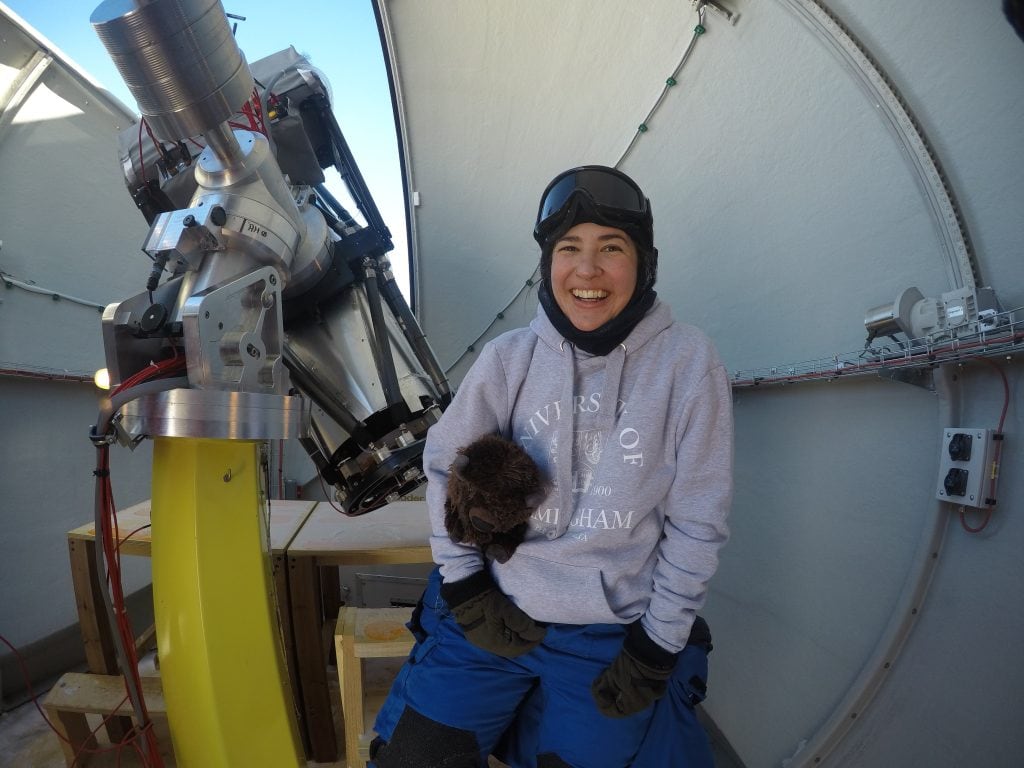
Magdalen Fellow by Examination in Physics, Dr George Dransfield, has led an international team of astronomers in the discovery of two of the lowest-density giant ‘super-puff’ planets ever found.
The research by the University of Oxford, in collaboration with Université Côte d’Azur/Observatoire de la Côte d’Azur and the University of Birmingham, has been published in Monthly Notices of the Royal Astronomical Society.
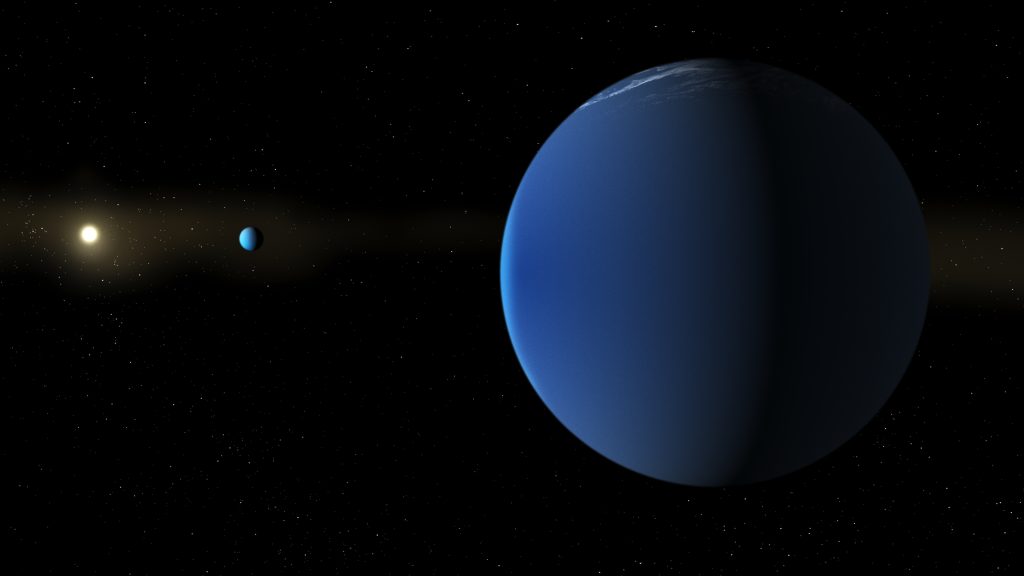
The newly discovered planets, TOI-791 b and TOI-791 c, orbit a star around 1,110 light-years from Earth in the constellation Volans. Although each is roughly the size of Jupiter, they contain only a tiny fraction of its mass. Their densities are just 0.038 and 0.047 grams per cubic centimetre, respectively, less dense than candy floss.
Only four other planetary systems containing multiple super-puff planets are known, making this an exceptionally rare opportunity for scientists to investigate how these unusual worlds formed.
Dr Dransfield said, “Only a handful of these super-puffy planets are known, and it is even rarer to find two in the same system. Their extremely low densities make them fascinating targets for understanding how planetary systems form and evolve.”
The discovery was made possible by eight years of observations from telescopes around the world, including the Antarctic Search for Transiting ExoPlanets telescope at Concordia Station in Antarctica. The continuous darkness of the Antarctic winter allowed researchers to observe the planets’ exceptionally long transits – each lasting more than 11 hours – in a single uninterrupted observation.
Astronomers are still debating how super-puff planets form. One leading theory is that they possess enormous hydrogen-and helium-rich atmospheres, making them much larger than their relatively small masses would suggest.
Reflecting on the discovery, Dr Dransfield said, “Exoplanet discovery has been accelerating at pace for more than three decades, but systems like TOI-791 remind us that we are still encountering unexpected outcomes of planet formation. Despite almost 6,300 planets discovered to date, nature continues to surprise us.”
The team now hopes to study the planets using the James Webb Space Telescope to reveal the composition of their atmospheres and gain further insight into how these extraordinary worlds came to exist.